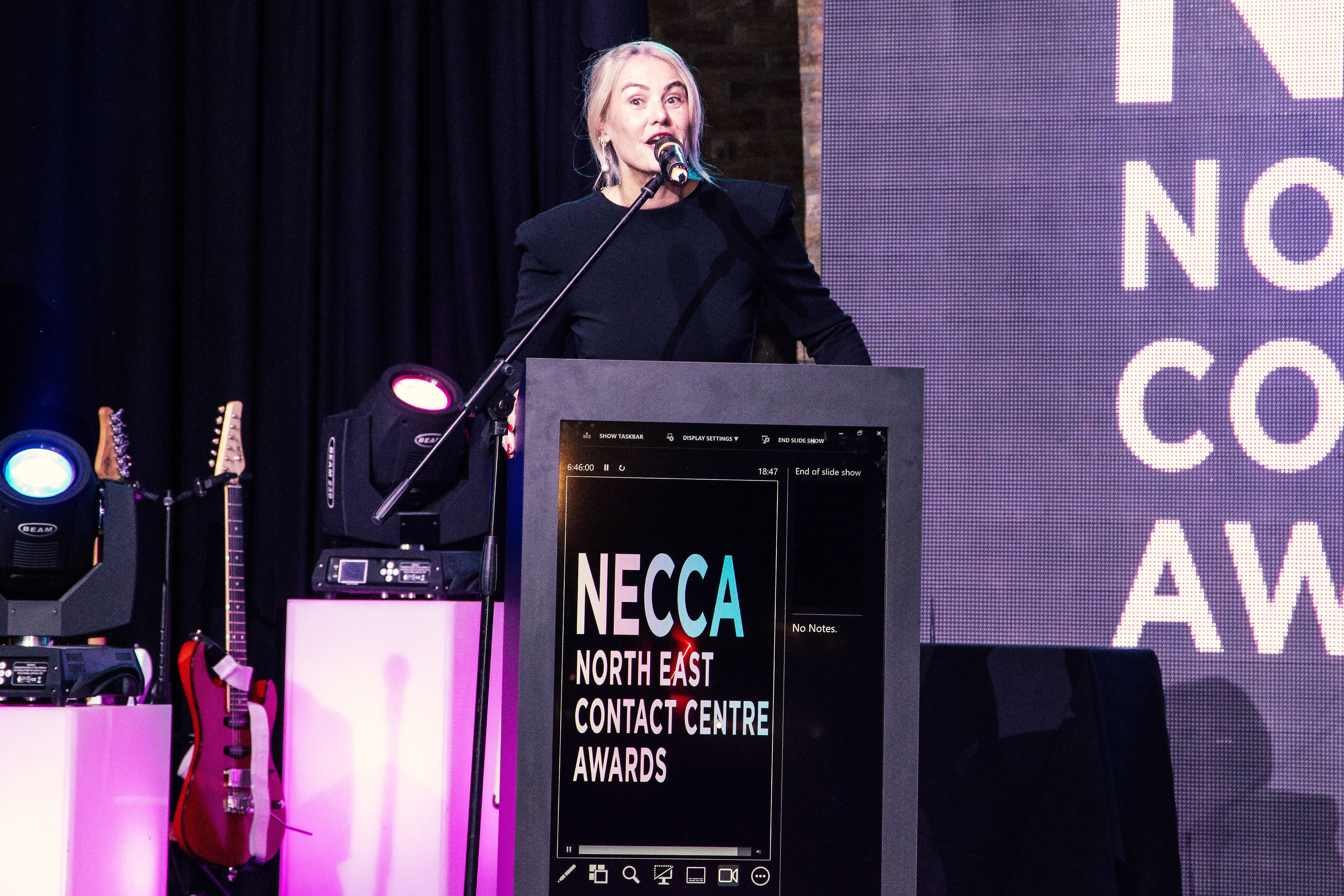
Inside the Judging Process at the North East Contact Centre Awards
Inside the Judging Process at the North East Contact Centre Awards
Sarah Hunt has judged contact centre awards across the UK and Europe for over a decade. Here, she talks about what rigorous judging really looks like — and why the North East gets it right.
More than six per cent of the North East's working population is employed in contact centres. It is one of the region's most significant industries, yet it rarely receives the recognition it deserves.
The North East Contact Centre Awards exist to change that.
We sat down with Head Judge Sarah Hunt to find out what goes into the judging process, what the panel looks for, and why she believes the awards matter for the long-term health of the sector.
A judge with roots in the region
Sarah's connection to the North East runs deeper than a judging brief.
Originally from Liverpool, she studied at Teesside University and spent three years living and working in Sunderland. Her career has since taken her to Newcastle and, more recently, Manchester - but ask her where she belongs and the answer is unambiguous. She is a northerner, and the professional relationships she has built across the region over the years have lasted.
That personal investment shapes how she approaches the role.
"The North East contact centre community is genuinely close-knit," she says. "People here care about doing things properly, and that comes through in the entries every year."
A panel drawn from across the industry
The judging panel reflects the breadth of the sector itself.
Professionals from retail, financial services, FMCG, the public sector, utilities and BPO sit alongside specialists in operations, transformation, customer experience, people and culture, data and analytics, resource planning and shared services.
That range is deliberate. Each entry is reviewed from multiple angles rather than measured against a single way of working. And it is that balance of perspectives, applied consistently, that produces a result the industry can trust.
Getting the process right
With a diverse panel comes the challenge of consistency.
Sarah's role as Head Judge includes overseeing calibration and ensuring every judge works to the same standard across all categories. This year, that work has been supported by refined scoring matrices, with clearer weighting and greater transparency on both sides of the process.
"Entrants put a lot of work into their submissions," she says. "The least we can do is make sure every entry is assessed fairly, against the same criteria, by people who understand the industry."
The goal is a process that is auditable and consistent, not just for the winners, but for every organisation that takes the time to enter.
How judges are developed
Judges do not simply sign up and start scoring.
Most begin by observing the process before moving into supporting roles. Full judging responsibilities come later, once they have a clear sense of the standards required. Lead judges then oversee groups of categories, providing an additional layer of quality control throughout.
Many on the panel are former winners or long-standing industry professionals. People who understand, from experience, what it takes to meet the standards they are now assessing. That credibility matters, both to the integrity of the process and to the entrants who go through it.
What judges take away
Judging is a voluntary commitment, carried out alongside demanding day jobs.
For most, it is a way of giving something back to an industry they have built careers in. But it is rarely a one-way exchange. Judges get an unusually wide view of how different organisations are tackling the same challenges - through technology, people strategies, cultural change or structural redesign - and take those insights back into their own work.
"You see things across the entries that you simply would not encounter in your own organisation," Sarah says. "It changes how you think about what good looks like."
What the entries reveal
One consistent finding across each judging cycle is the variety of approaches on display.
Organisations across the North East face many of the same pressures, but the solutions they arrive at rarely look alike. There is no single template for success here. What distinguishes the strongest entries is not that they followed a formula. It is that they understood their own context clearly and built something that worked for them.
"Originality is not about being different for its own sake," Sarah notes. "It is about solving the right problem in a way that actually fits your organisation. The entries that stand out are always the ones where you can tell the team really understood what they were trying to achieve."
Why entering matters
Awards entry is sometimes seen as an afterthought. Something organisations consider when things are going well and time allows. Sarah's view is more straightforward.
Entering gives teams a structured reason to document what they have achieved, articulate it clearly and share it with peers. For individuals, a nomination or a win carries real weight in career development. For the sector as a whole, the awards provide visible evidence of what the region's contact centre industry is capable of, and that matters when making the case for investment and talent.
"Every entry adds to the picture of what this industry is achieving," she says. "Even if you don't win, going through the process is worth it."
An invitation to take part
With over 30 years in the contact centre industry and more than a decade judging programmes across the UK and Europe, Sarah has seen what recognition does for individuals, teams and organisations alike.
Her advice to anyone considering entering this year is simple: do not overthink it. The work is already there. The awards are an opportunity to show it.
Every story told through the process helps raise the bar for the next one.
